
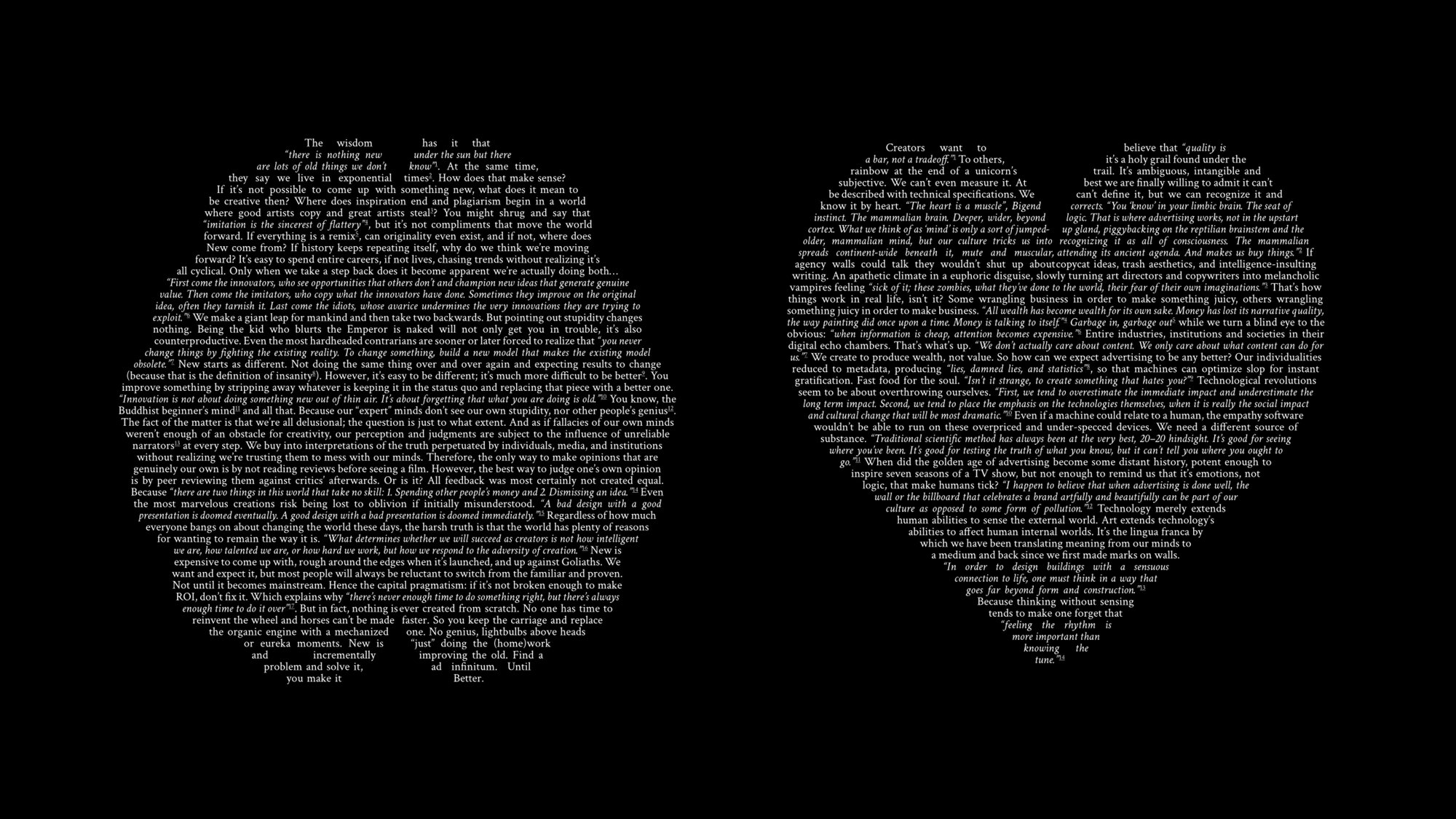
On Hearts & Minds
Minds
The wisdom has it that "there is nothing new under the sun but there are lots of old things we don't know"[1]. At the same time, they say we live in exponential times[2]. How does that make sense? If it's not possible to come up with something new, what does it mean to be creative then? Where does inspiration end and plagiarism begin in a world where good artists copy and great artists steal[3]? You might shrug and say that "imitation is the sincerest of flattery"[4], but it's not compliments that move the world forward. If everything is a remix[5], can originality even exist, and if not, where does New come from? If history keeps repeating itself, why do we think we're moving forward? It's easy to spend entire careers, if not lives, chasing trends without realizing it's all cyclical. Only when we take a step back does it become apparent we're actually doing both…
"First come the innovators, who see opportunities that others don't and champion new ideas that generate genuine value. Then come the imitators, who copy what the innovators have done. Sometimes they improve on the original idea, often they tarnish it. Last come the idiots, whose avarice undermines the very innovations they are trying to exploit."[6] We make a giant leap for mankind and then take two backwards. But pointing out stupidity changes nothing. Being the kid who blurts the Emperor is naked will not only get you in trouble, it's also counterproductive. Even the most hardheaded contrarians are sooner or later forced to realize that "you never change things by fighting the existing reality. To change something, build a new model that makes the existing model obsolete."[7]
New starts as different. Not doing the same thing over and over again and expecting results to change (because that is the definition of insanity[8]). However, it's easy to be different; it's much more difficult to be better[9]. You improve something by stripping away whatever is keeping it in the status quo and replacing that piece with a better one. "Innovation is not about doing something new out of thin air. It's about forgetting that what you are doing is old."[10] You know, the Buddhist beginner's mind[11] and all that. Because our "expert" minds don't see our own stupidity, nor other people's genius[12].
The fact of the matter is that we're all delusional; the question is just to what extent. And as if fallacies of our own minds weren't enough of an obstacle for creativity, our perception and judgments are subject to the influence of unreliable narrators[13] at every step. We buy into interpretations of the truth perpetuated by individuals, media, and institutions without realizing we're trusting them to mess with our minds. Therefore, the only way to make opinions that are genuinely our own is by not reading reviews before seeing a film. However, the best way to judge one's own opinion is by peer reviewing them against critics' afterwards. Or is it? All feedback was most certainly not created equal. Because "there are two things in this world that take no skill: 1. Spending other people's money and 2. Dismissing an idea."[14] Even the most marvelous creations risk being lost to oblivion if initially misunderstood. A bad design with a good presentation is doomed eventually. A good design with a bad presentation is doomed immediately.[15]
Regardless of how much everyone bangs on about changing the world these days, the harsh truth is that the world has plenty of reasons for wanting to remain the way it is. What determines whether we will succeed as creators is not how intelligent we are, how talented we are, or how hard we work, but how we respond to the adversity of creation.[16] New is expensive to come up with, rough around the edges when it's launched, and up against Goliaths. We want and expect it, but most people will always be reluctant to switch from the familiar and proven. Not until it becomes mainstream. Hence the capital pragmatism: if it's not broken enough to make ROI, don't fix it. Which explains why "there's never enough time to do something right, but there's always enough time to do it over"[17].
But in fact, nothing is ever created from scratch. No one has time to reinvent the wheel and horses can't be made faster. So you keep the carriage and replace the organic engine with a mechanized one. No genius, lightbulbs above heads or eureka moments. New is "just" doing the (home)work and incrementally improving the old. Find a problem and solve it, ad infinitum. Until you make it Better.
Hearts
Creators want to believe that "quality is a bar, not a tradeoff."[18] To others, it's a holy grail found under the rainbow at the end of a unicorn's trail. It's ambiguous, intangible and subjective. We can't even measure it. At best we are finally willing to admit it can't be described with technical specifications. We can't define it, but we can recognize it and know it by heart. "The heart is a muscle", Bigend corrects. "You 'know' in your limbic brain. The seat of instinct. The mammalian brain. Deeper, wider, beyond logic. That is where advertising works, not in the upstart cortex. What we think of as 'mind' is only a sort of jumped-up gland, piggybacking on the reptilian brainstem and the older, mammalian mind, but our culture tricks us into recognizing it as all of consciousness. The mammalian spreads continent-wide beneath it, mute and muscular, attending its ancient agenda. And makes us buy things."[19]
If agency walls could talk they wouldn't shut up about copycat ideas, trash aesthetics, and intelligence-insulting writing. An apathetic climate in a euphoric disguise, slowly turning art directors and copywriters into melancholic vampires feeling sick of it; these zombies, what they've done to the world, their fear of their own imaginations.[20] That's how things work in real life, isn't it? Some wrangling business in order to make something juicy, others wrangling something juicy in order to make business. All wealth has become wealth for its own sake. Money has lost its narrative quality, the way painting did once upon a time. Money is talking to itself.[21] Garbage in, garbage out[22] while we turn a blind eye to the obvious: when information is cheap, attention becomes expensive.[23] Entire industries, institutions and societies in their digital echo chambers. That's what's up. We don't actually care about content. We only care about what content can do for us.[24] We create to produce wealth, not value. So how can we expect advertising to be any better? Our individualities reduced to metadata, producing "lies, damned lies, and statistics"[25], so that machines can optimize slop for instant gratification. Fast food for the soul. Isn't it strange, to create something that hates you?[26]
Technological revolutions seem to be about overthrowing ourselves. First, we tend to overestimate the immediate impact and underestimate the long term impact. Second, we tend to place the emphasis on the technologies themselves, when it is really the social impact and cultural change that will be most dramatic.[27] Even if a machine could relate to a human, the empathy software wouldn't be able to run on these overpriced and under-specced devices. We need a different source of substance. Traditional scientific method has always been at the very best, 20–20 hindsight. It's good for seeing where you've been. It's good for testing the truth of what you know, but it can't tell you where you ought to go.[28]
When did the golden age of advertising become some distant history, potent enough to inspire seven seasons of a TV show, but not enough to remind us that it's emotions, not logic, that make humans tick? I happen to believe that when advertising is done well, the wall or the billboard that celebrates a brand artfully and beautifully can be part of our culture as opposed to some form of pollution.[29]
Technology merely extends human abilities to sense the external world. Art extends technology's abilities to affect human internal worlds. It's the lingua franca by which we have been translating meaning from our minds to a medium and back since we first made marks on walls. In order to design buildings with a sensuous connection to life, one must think in a way that goes far beyond form and construction.[30] Because thinking without sensing tends to make one forget that feeling the rhythm is more important than knowing the tune.[31]
Bierce, A. (1911) The Devil's Dictionary, in The Collected Works of Ambrose Bierce, Vol. 7. New York: Neale. [Also published as The Unabridged Devil's Dictionary, eds. Schultz, D.E. and Joshi, S.T. (2001), p. 225. Athens, GA: University of Georgia Press.] / The Bible (King James Version) (1611) Ecclesiastes, 1:9. ↩︎
Fisch, K. and McLeod, S. (2006 [presentation]; 2007 [YouTube upload]) Did You Know? / Shift Happens [online video]. ↩︎
Eliot, T.S. (1920) The Sacred Wood: Essays on Poetry and Criticism. London: Methuen. [Commonly misattributed to Picasso, P., via Jobs, S.] ↩︎
Colton, C.C. (1820) Lacon: or, Many Things in Few Words. London: Longman. ↩︎
Ferguson, K. (2012) Everything is a Remix [online video series]. ↩︎
Buffett, W. (2008) "Three I's of every business cycle" [interview with Charlie Rose, PBS, 1 October 2008]. / The extended paraphrase quoted here is from: Taylor, B. (2008) "Wisdom of Warren Buffett: On Innovators, Imitators, and Idiots", Harvard Business Review, 9 October. ↩︎
Fuller, R.B. [widely attributed paraphrase; exact wording unverified in primary sources]. Earliest documented version: Vance, M. and Deacon, D. (1995) Think Out of the Box. Franklin Lakes, NJ: Career Press, p. 138. ↩︎
Narcotics Anonymous (1981) Narcotics Anonymous Basic Text [pamphlet]. World Service Conference of Narcotics Anonymous. [Commonly misattributed to Einstein, A.] ↩︎
Ive, J. (n.d.) [Attributed remark in various interviews]. ↩︎
Attributed to Nafus, D. or Wagner, R. [unverified; original source unknown]. The underlying idea closely reflects Wagner, R. (1975) The Invention of Culture. Chicago: University of Chicago Press, in which Wagner argues that all cultural activity involves acts of invention that participants have ceased to recognize as such. ↩︎
Suzuki, S. (1970) Zen Mind, Beginner's Mind. New York: Weatherhill. ↩︎
Kruger, J. and Dunning, D. (1999) "Unskilled and Unaware of It: How Difficulties in Recognizing One's Own Incompetence Lead to Inflated Self-Assessments", Journal of Personality and Social Psychology, 77(6), pp. 1121–1134. / Dunning, D., interviewed by Powell, C.S. (2024) "The Dunning-Kruger Effect Shows that People Don't Know What They Don't Know", Scientific American, 5 April. ↩︎
The term "unreliable narrator" was coined by Booth, W.C. (1961) The Rhetoric of Fiction. Chicago: University of Chicago Press. ↩︎
Fried, J. (2012) "Give it five minutes", Signal v. Noise [blog]. ↩︎
Akin, D. (n.d.) "Akin's Laws of Spacecraft Design" [online]. ↩︎
Ashton, K. (2015) How to Fly a Horse: The Secret History of Creation, Invention, and Discovery. New York: Doubleday. ↩︎
A widely circulated saying of unknown origin, recorded by Conway, M.E. (1968) "How Do Committees Invent?", Datamation, 14(4), pp. 28–31, who cited it as a pre-existing observation. ↩︎
Zhuo, J. (2011) "Quality is not a tradeoff", Medium [blog]. ↩︎
Gibson, W. (2003) Pattern Recognition. New York: G.P. Putnam's Sons. ↩︎
Jarmusch, J. (dir.) (2013) Only Lovers Left Alive [film]. Recorded Picture Company. ↩︎
Cronenberg, D. (dir.) (2012) Cosmopolis [film]. Entertainment One. / DeLillo, D. (2003) Cosmopolis. New York: Scribner. ↩︎
Fuechsel, G. (c.1958–62) GIGO [coined term]. IBM, New York. [First known printed use: Crowley, R.J. (1963) "Robot Processes Tax Returns", Associated Press, 1 April] ↩︎
Gleick, J. (2011) The Information: A History, a Theory, a Flood. New York: Pantheon Books. / Frost, B. (2013) Death to Bullshit [online]. ↩︎
Gertz, T. (2015) "Design machines", Louder Than Ten [online]. ↩︎
Anon. (1891) Letter to the editor, National Observer, 13 June, p. 93. [Earliest known printed instance of the phrase] ↩︎
Garland, A. (dir.) (2015) Ex Machina [film]. Film4 / DNA Films. ↩︎
Norman, D.A. (1998) "Drop Everything You're Doing", Chapter 1 in The Invisible Computer. Cambridge, MA: MIT Press. ↩︎
Pirsig, R.M. (1974) Zen and the Art of Motorcycle Maintenance: An Inquiry into Values. New York: William Morrow. ↩︎
Clow, L. (2009) in Pray, D. (dir.) Art & Copy [documentary]. Art & Copy LLC. ↩︎
Zumthor, P. (1998) Thinking Architecture. Basel: Birkhäuser. ↩︎
Maeda, J. (2025) "The Art of Desirable Accidents: Embracing Improvisation", Medium [blog]. ↩︎