Confessions Pt.2: Peace Time Disclosure, War Time Regret
Pt.1: When You Text Into the Abyss, the Abyss Doesn’t Text Back Into You
Friends, followers, and subscribers aren't necessarily your supporters and allies. Some are snoops or opportunists. Others might be enemies. You never know.
Social media isn't sharing life's moments. It's broadcasting private-self to strangers who interpret and use the information however they want. Individuals, companies, and governments. The surveillance capitalism hydra has endless faces and plenty of reasons.
Photos and videos reveal what you're doing, who you're with, where, and when. All of that is being exploited. But writing is equally, if not even more intimate. When you share your thoughts you expose and reveal what you think, how you think, what you believe in, what you care about, and where you're vulnerable. To anyone who wants to know or might want to in the future. For whatever reason.
There are too many people out there whose genius is coming up with ways to weaponize what they know about you for their benefit or your detriment. Even more of those who judge and reject you for your opinions or jump to conclusions about your character and treat you differently because of a superficial read of you and your life from social media profiles.
Everything you say and do, online and offline, can and will be used against you in the court of public opinion. Business, personal; it doesn't matter.
People were passed on, fired, canceled, or broken up with for less than a clumsy tweet left too open to interpretation. Regardless of whether conclusions were true or not. Myths and rumors spread faster and stick harder than the silly old thing that is the truth. It takes a lifetime to build a reputation but only five minutes for a bad actor to tear it down.
All this reads like conspiracy theories when it's in fact decade-old news.
The problem isn't just living in public. Private channels are equally taxing. The most dangerous timeline isn't your profile; it's your sent folder. If I had a pound for every conflict caused by a chat text…
Did you ever notice how much gets lost in translation when we communicate over the wire? The lack of behavioral visual cues, sender and receiver being in wildly different time, location, and emotional spaces makes us read into things even in business settings.
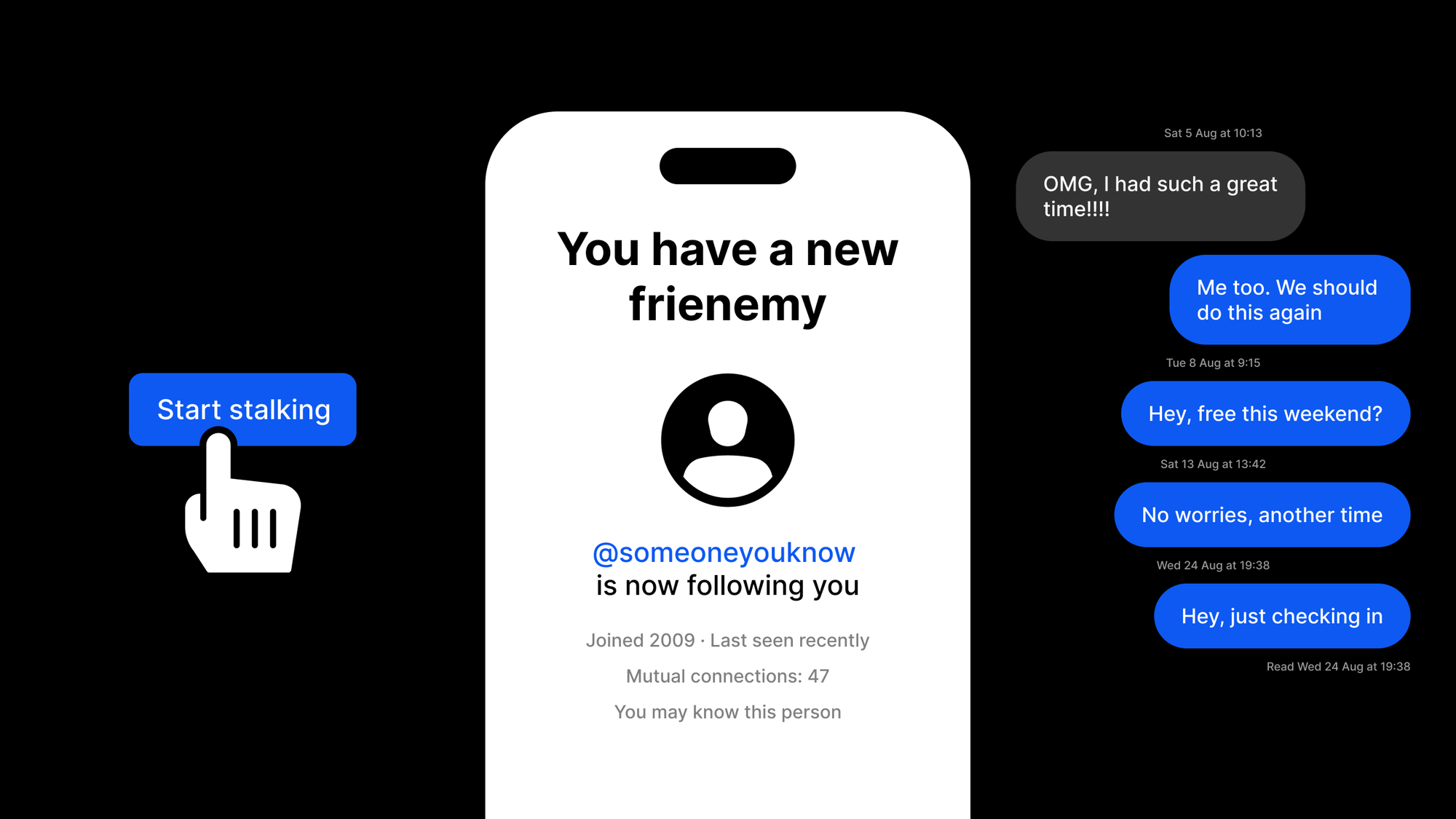
The "…" typing, "online" status, and "read" UI indicators don't just exploit our insecurities to keep us active longer. They affect our perception of the sender's reactions to our texts and color their words with the tone we're projecting. You know, when they're typing, then they stop, typing again, stop, typing, stop, disappear offline. They must be pissed off about what was just said. When in fact, they were simply in the queue and had to stop texting to pay for their groceries.
When it comes to fears concerning people we love and depend on, insecurities and crippling doubt will fuck with anyone's mind and push any one of us into paranoid irrational behavior.
As a society we now predominantly communicate through text. But text is a lossy medium where every flaw dilutes the meaning exponentially. Writing clearly is a skill that most people aren't adequately trained in, and now we've also normalized being careless with it. Slack grammar. Teenage slang bleeding from DMs into adult conversation. Emerging emoji lingo where many symbols have multiple meanings, which change over time depending on the (sub)cultural context and even secret subtext because IYKYK.
Could it be there's a link between things getting lost in translation, loneliness epidemic, and people dodging confrontation by hiding behind screens?
Things have become absurd.
Closing chat apps if simultaneously online. Reading texts in airplane mode to avoid double tick read marks. Checking phone every 10 minutes on average, "forgetting" to reply, but taking offense when their own message sits unanswered for an afternoon.
And then there's ghosting. Leaving a person without closure or explanation they could learn from, which we've apparently collectively decided is fine, even in a business context.
Part of why the remote-work fight stays so charged is that the wire makes dodging accountability easy and enough people prove it to keep the suspicion alive.
The bottom line is, be careful about what you disclose during peacetime, because chances are you'll regret the other side having knowledge of it during wartime. Especially things told in confidence and out of love.
It's a big responsibility to hit that publish button. We came to think it's not because it's effortless and because everyone is doing it. Facts are telling a different story, though.
Online spaces distort reality, deform self-image, and bring out our ugly sides. It takes deep introspection to be clear about what you are doing, why you are doing it, what you're willing and not willing to do, what you're gaining and what you're sacrificing every time you post.
The instant gratification reward mechanism also makes it very tempting to perform for the audience. Self-censoring your beliefs or saying things you don't really believe in both lead to abandoning yourself for a persona you think you need to be, or they want you to be in order to be successful or loved.
Being ignored is painful. Getting likes and replies is addictively pleasurable. So you become a dancing monkey.
Public profiles aren't genuine enough to be considered as digital diaries or truthful portraits of real people. They are curated, often staged, maybe even completely doctored autobiographies, designed to be flattering or perceived as influential. Nothing new there. What I don't hear talked about enough is that most profiles are not curated enough. People are leaving behind ugly legacies publicly available for generations to look up, frown upon, and judge.
Remember kids, in the metaverse, you can stalk dead people.
When you know you're being watched and you know they judge your every move, what you say and do becomes a function of PR and optics. Until you no longer know who you are and what you really believe in.
Fuck that.
Congressional hearings and regulations aren't going to protect us. You know what's 10x more effective? Boycott.
Making friends and creating opportunities online is great. It's why we nerds embraced and loved the early network. We could find our own tribe and likeminded people pursuing same things.
However, now that every rando is online and the volume of bot traffic is surpassing human traffic, filtering out noise to find quality human signal has become near impossible.
Everybody is everywhere now. And everything has been gamed, gamified, or rigged to convert DAU/WAU/MAU volume into cold hard $. Even serious content and especially search. Meanwhile, every bit of footprint we leave online is stored, backed up, promised to be deleted after a certain time without any real oversight, and continues to be actively used against us by individuals, companies, governmental offices and agencies every day for more than a decade now.
Why would you expose yourself to any of that? Likelihood of a high-reward outcome is low. High risk is a certainty.
I don't need social media to live comfortably. None of us do. Sure, I have social needs. But they won't be met online. They never were. For most things in life, but human-to-human interaction especially, the digital version is a poor substitute for its real-life equivalent.
The best and easiest strategy was simply to stop posting. So I deleted accounts, wiped my timeline, and started minding my own business.
Then I figured, the same principle applies IRL. You can save yourself a lot of grief and unnecessary headwinds simply by staying quiet and releasing only information that is required and directly relevant to the situation. Especially about yourself and your life. If someone really wants to know something, they'll ask. If they do, the time and situation context will indicate their agenda and you can make an informed decision whether to disclose. If they don't, they aren't interested enough or don't want to get involved. Guess what: most people don't.
The fact people won't shut up about themselves, but don't care enough to ask about you hurts in the beginning.
Once you accept the brutal fact that no one really cares about you, and you build up psychological resilience to live a content life without anyone's attention, you achieve two things.
It reveals people who genuinely do care about you. And it makes you socially unshakable.
"When you have friends, you form a band. When you're lonely, you write."
— Marilyn Manson
 Natan Novum